What Should I Expect During a Holistic Healing Session?
If you have never experienced a holistic healing session before, it is completely normal to wonder what actually happens once you walk through the door. Are you going to lie on a table? Do you have to talk the whole time? Is someone going to touch you? Do you need to understand energy, chakras, meridians, or any of this before you come?
The answer is much simpler than people sometimes expect. You really just get to come as you are.
Holistic healing is deeply personal work, and no two sessions are exactly alike because no two people walk through the door carrying exactly the same thing. You may be coming because your body feels exhausted. You may be grieving. You may feel anxious, disconnected, overwhelmed, physically uncomfortable, spiritually lost, emotionally stuck, or simply aware that something in your life feels out of alignment and you are ready to pay attention to it.
Sometimes you cannot even name what is wrong yet. That is okay too.
What Is Holistic Healing?
Holistic healing looks at the whole person. Your physical body matters, and so do your emotions, your thoughts, your nervous system, your energy, your experiences, your relationships, your habits, your beliefs, and the way you are moving through your life.
For thousands of years, healing traditions around the world have understood that these pieces of us influence one another. Medical Qigong, Traditional Chinese Medicine, Reiki, meditation, breathwork, acupressure, sound therapy, energy medicine, bodywork, and other complementary wellness practices all approach that relationship in different ways.
At Healing Thyme, I am rarely interested in simply asking, “Where does it hurt?” I want to understand what your body has been carrying, what has been happening in your life, where patterns may be repeating, how you are sleeping, what you are feeling, and what your body seems to be asking for.
That does not mean every ache has an emotional explanation or every illness has an energetic cause. Human beings are far more complex than that. It simply means that when we are working with a whole human being, I believe it makes sense to actually work with the whole human being.
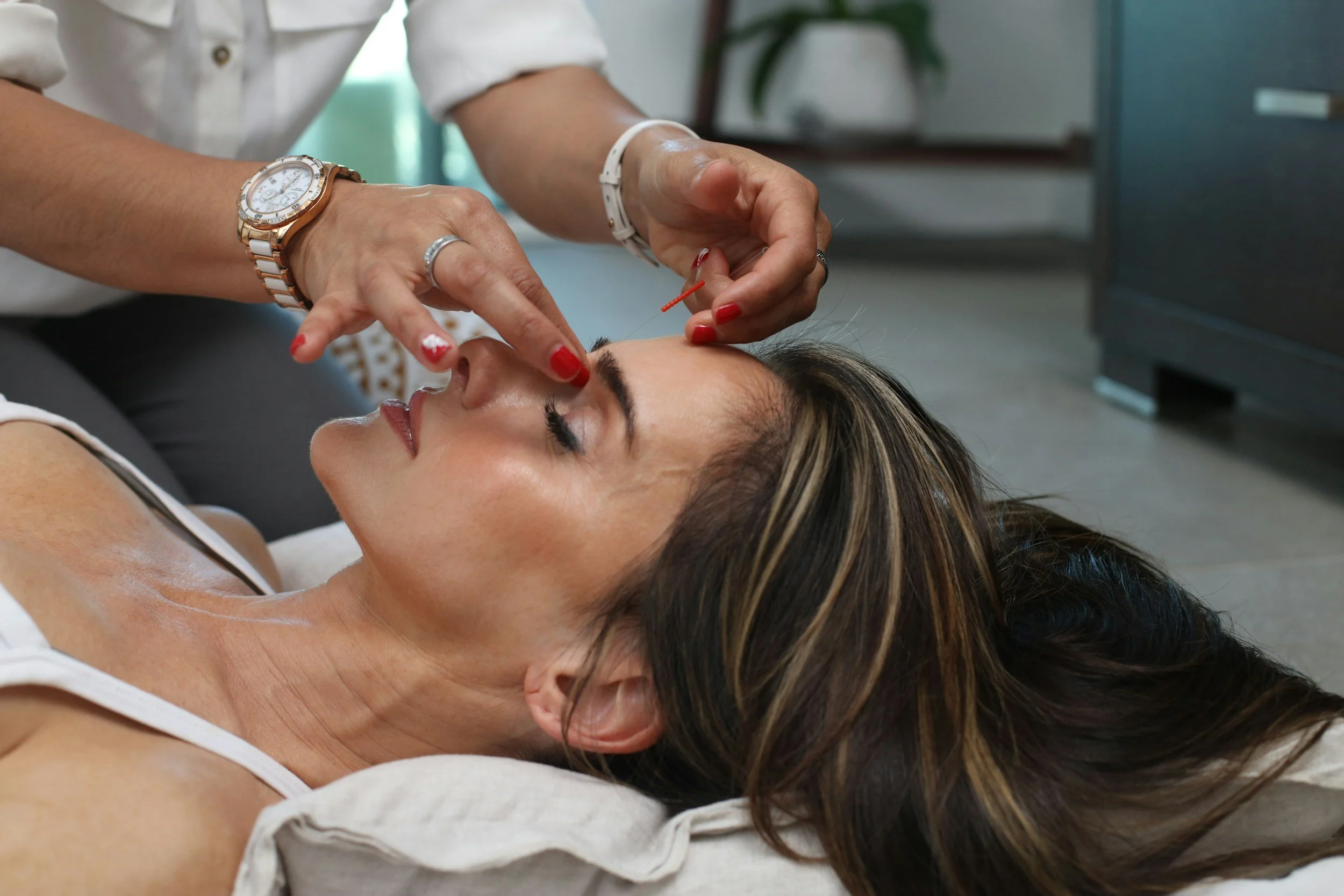
Depending on what you need, a session may incorporate Medical Qigong, Reiki, breathwork, guided meditation, sound therapy, acupressure, foot zoning, emotional or body coding techniques, energetic needling, visualization, intuitive work, or another modality. Sometimes we use several. Sometimes your entire session is centered around one.
The work changes because you change.
Your First Appointment
Most sessions begin with a conversation.
I want to know what brought you in. I may ask how you are feeling physically and emotionally, what has been happening recently, whether there are symptoms or patterns you have been noticing, what other care you are receiving, and what you would like support with.
You are always in charge of what you share.
There is no prize for giving me your entire life story in the first ten minutes, and you never have to disclose something you are not comfortable discussing. Sometimes the most important thing someone can tell me is simply, “I don't really know what is wrong. I just know I don't feel like myself.”
That is enough information to begin.
This conversation also gives us a chance to talk about the session itself. If touch may be involved, we talk about that. If there is something you absolutely do not want included, tell me. If you are nervous, tell me. If you have questions, ask every single one of them.
I want you to feel informed and comfortable participating in your own care.
What Happens During the Session?
For many sessions, you will lie fully clothed on a comfortable treatment table. Depending on the modality, you may also sit, stand, breathe, move, talk, meditate, or participate in simple Qigong exercises.
I often begin by helping your body settle.
Most of us move through our days with far more stimulation than we realize. Phones are ringing. Children need something. Work is demanding something. We are thinking about tomorrow while answering something from yesterday, and somewhere in the middle of all of it our bodies are quietly trying to keep up.
Sometimes the first beautiful thing that happens in a healing session is simply that everything gets quiet.
From there, I may work with the energetic field above the body, gently place my hands on approved areas, work with acupressure points or meridians, guide you through breathwork or visualization, use sound bowls or tuning instruments, incorporate essential oils when appropriate, or use other techniques depending on the session we have chosen together.
Medical Qigong and Reiki sessions may involve working both directly with and slightly above the body. In Medical Qigong, practitioners work within a traditional energetic framework involving Qi, meridians, organs, energetic patterns, and the movement or stagnation of energy. Reiki has its own lineage, philosophy, and energetic practice. These traditions are not interchangeable, even though someone receiving them may notice similar experiences of relaxation, warmth, tingling, emotional movement, spaciousness, or calm.
And sometimes you feel almost nothing dramatic at all.
That does not mean you did it wrong.
What Might I Feel?
This is probably one of the questions I hear most often, and the answer is truly anything from very little to quite a lot.
Some people feel warmth moving through their body. Some describe tingling, pulsing, heaviness, lightness, waves, colors, memories, emotions, or an almost dreamlike state. Some people become extraordinarily relaxed. Some people cry. Some laugh. Some suddenly remember something they have not thought about in years.
Some people fall asleep.
I love when people apologize for falling asleep because I promise I am not offended. Your healing session is not a performance. You do not need to stay awake and concentrate really hard on healing.
Your body gets to experience the session however it experiences it.
There are also people who finish a session and say, “I don't know exactly what happened, but I feel different.”
That is one of my favorite sentences.
Emotional Release Can Happen
Holistic and somatic practices can sometimes bring emotions, memories, or physical sensations closer to the surface. Human beings carry experiences in complicated ways, and the relationship between emotion, memory, stress, the nervous system, and the physical body is incredibly interconnected.
You may find yourself unexpectedly emotional during a session. You may cry without being entirely sure why. You may feel anger, relief, grief, joy, tenderness, or something you cannot immediately name.
You do not need to analyze it while it is happening.
Sometimes the kindest thing we can do is allow an experience to move through without immediately demanding an explanation from it.
If emotion arises, you are never expected to suppress it for my comfort. My job is to hold a grounded, compassionate, nonjudgmental space while you move through your own experience.
What Happens Afterward?
At the end of the session, we usually take a little time to talk.
Depending on the type of work we have done, I may share energetic observations, patterns I noticed, intuitive impressions, or things that came up during the session. You may also have things you noticed or want to talk through.
Sometimes I recommend very simple practices afterward. Drink water. Take a walk. Journal about something that came forward. Spend a few minutes outside. Practice a Qigong movement. Pay attention to your dreams. Rest if your body is asking you to rest.
I do not want you leaving with a twelve-step homework assignment for becoming a better human.
Healing should help you come home to yourself, not give you one more impossible thing to accomplish.
Some people leave feeling incredibly energized. Others feel peaceful, emotional, tender, tired, clearheaded, hungry, grounded, or ready for a nap. Experiences vary, and you may continue noticing changes in the hours or days following a session as you reflect on what came up and return to your regular life.
I encourage people to stay curious.
Notice what feels different without trying to force something dramatic to happen.
You Do Not Have to Believe the “Right” Thing
You do not need to know what a meridian is. You do not need to understand chakras. You do not need to be spiritual. You do not need to meditate every morning at sunrise or own a single crystal.
You also do not have to believe exactly what I believe.
I have spent years studying these practices, their philosophies, their traditions, their applications, and the way they interact with the physical, emotional, mental, energetic, and spiritual parts of a human being. I believe deeply in this work because I have studied it, practiced it, experienced it, and watched what can happen when people are finally given the space and tools to reconnect with themselves.
You get to experience it for yourself.
Come curious.
Come skeptical.
Come exhausted.
Come hopeful.
Come completely unsure what you need.
Just come as you are.
That is enough.
A holistic healing session is ultimately a place to slow down long enough to listen again. To your body. To your emotions. To the places inside you that may have been whispering underneath the noise of everything else.
Sometimes healing begins with doing something.
Sometimes it begins with finally hearing yourself.
If you feel called to experience this work, you can book a holistic healing session with Healing Thyme and we will begin exactly where you are.